 how-to
How to Avoid Remodeling Budget Overruns
Table of Contents
- Define Your Project Scope Before Work Begins
- Set a Realistic Total Remodeling Budget
- Build a Remodeling Contingency Budget for Hidden Costs
- How to Compare Contractor Estimates Line by Line
- Understand the Remodeling Change Order Process
- Track Spending with a Home Renovation Cost Tracking Spreadsheet
- Separate Must-Haves from Nice-to-Haves to Control Costs
- Frequently Asked Questions
Last Updated: October 16, 2026
Define Your Project Scope Before Work Begins
The most expensive mistake homeowners make isn't picking the wrong contractor.
A vague scope creates chaos. Contractors fill gaps with assumptions. Assumptions become change orders. Remodeling budget overruns follow.
Before you get a single estimate, write down exactly what you're remodeling.
Here's what this prevents:
- Contractors quoting different scopes (one includes demolition, another doesn't)
- Surprise costs when hidden work surfaces
- Scope creep during construction
- Disputes over what was promised
Pro Tip: Take photos of the space you're remodeling. Mark up the images with notes about what stays and what goes.
Set a Realistic Total Remodeling Budget
Most homeowners set a budget first, then discover it's too low halfway through work.
A realistic budget includes:
- Materials and labor
- Permits and inspections
- Contingency for unexpected costs (we'll cover this next)
- Design and planning time
- Potential code upgrades
Don't lowball yourself. A budget that's too tight pressures you to cut corners and makes contractors nervous, they'll either pass on the job or pad their estimate to protect themselves.
Your budget should feel achievable, not optimistic. If a project typically costs $30,000 and you have $20,000, that's a gap worth acknowledging now, not discovering mid-project.
Build a Remodeling Contingency Budget for Hidden Costs
Hidden costs are guaranteed; the only question is how much you'll find. Walls come down and reveal rotted framing, corroded plumbing, code-violating electrical, mold, or asbestos, not the contractor's fault, but the cost of working with existing structures.
A remodeling contingency budget is your safety net for surprises. But "set aside 10%" is advice you can't act on; the right reserve depends on what kind of uncertainty your project carries.
Size the reserve by the drivers of uncertainty
Four factors push your contingency up or down:
1. How much of the home you're opening up. A cosmetic refresh touches almost nothing hidden; a gut renovation opens walls, floors, and ceilings, every opening is a chance to find something.
2. The age and condition of the systems. A home built in the last 15-20 years likely has code-compliant electrical, modern plumbing, and intact framing.
3. Whether you're changing the layout. Moving a wall, relocating a drain, or adding a fixture means new rough-in work, where code upgrades and structural fixes surface.
4. How firm your scope is. If you've picked every finish, signed a fixed-price contract, and locked the drawings, your uncertainty is mostly hidden conditions.
A starting range by project type
Use these as starting points, then adjust up or down using the four drivers above:
- Cosmetic refresh, newer home (under 20 years), layout unchanged: 5-10% of the construction budget
- Moderate remodel, mid-age home, layout mostly unchanged: 10-15%
- Major renovation, older home, layout changes: 15-20%
- Whole-home or structural renovation, or a home with known deferred maintenance: 20% or more
Example: a $30,000 kitchen renovation in a 40-year-old home with the sink and range staying put sits in the 10-15% band, roughly $3,000 to $4,500. Relocate the sink and remove a wall, and it moves toward the top of the range or above.
Separate the two kinds of contingency
Experienced remodelers split the reserve into two buckets:
- Hidden-conditions reserve, for things nobody could see: rot, mold, failed wiring, code violations. You don't control whether these appear, only whether you can pay for them.
- Owner-change reserve, for the upgrades and additions you decide on mid-project. This bucket is entirely within your control, and it's the one that quietly drains budgets when it isn't tracked separately.
Keeping them separate tells you the truth: if your hidden-conditions reserve is untouched but your owner-change reserve is empty, you have a discipline problem, not a bad-luck problem.
Where the money should live
Keep contingency funds liquid and separate from the construction account, and don't fund the contingency by borrowing against the project's own progress payments. Finish without tapping it and you have a buffer for punch-list items or the next project, not a reason to upgrade mid-stream.
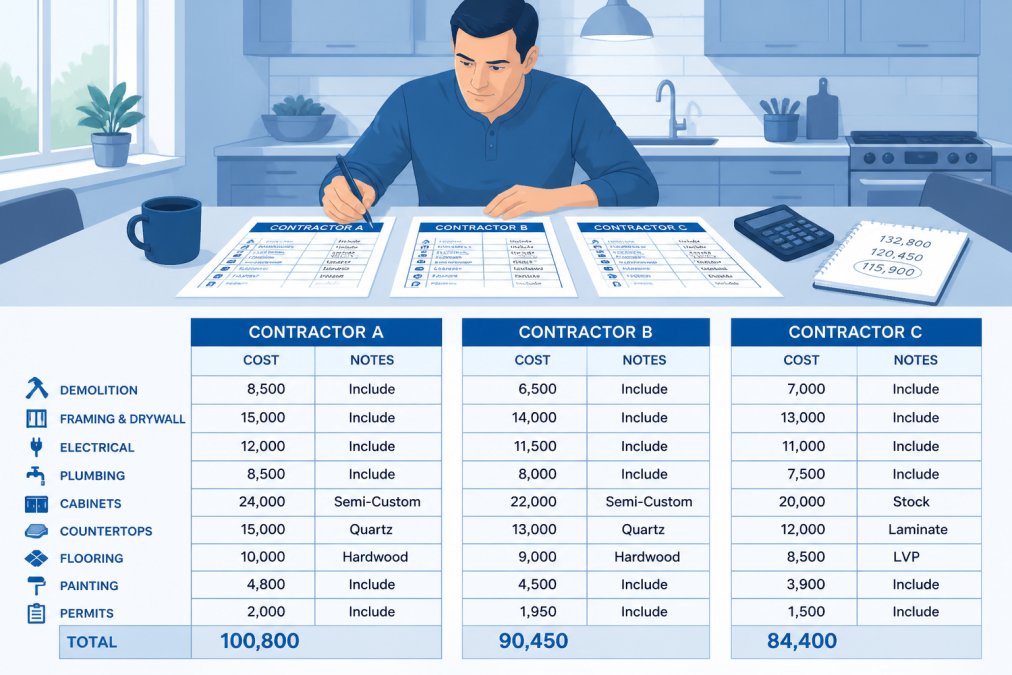
How to Compare Contractor Estimates Line by Line
Three contractors give you three wildly different quotes: $15,000, $22,000, $28,000. Which one is right? You can't tell from the bottom line. What matters is what each bid includes, and what it quietly leaves out. A low bid is often a bid with holes, and those holes get filled with change orders once work starts.
Normalize every bid before you compare it
Contractors format estimates differently, one lists 14 line items, another lists 4. Before comparing prices, rewrite each bid into the same categories:
- Demolition and disposal, dumpster, haul-away, dump fees
- Permits and inspections, who pulls the permit, who pays the fee
- Rough-in trades, electrical, plumbing, HVAC, each as its own line
- Structural and framing, including any repair allowance for hidden damage
- Drywall, paint, and finishes, separated so you can see labor vs. material
- Fixtures and materials, labeled as allowance or fixed price (see below)
- Labor, broken out by trade, not lumped into one number
- Cleanup and punch list, final walkthrough and touch-ups
- Payment schedule and deposit, not a cost, but part of the bid
If a bid can't be mapped into these categories, that's your first red flag. Vague line items like "labor" or "miscellaneous" hide padding and omissions.
Read the exclusions page first
Every complete bid has an exclusions or "not included" list. Read it before the price. Common exclusions that turn a low bid into an expensive one:
- Permit fees and inspection costs
- Dumpster rental and debris hauling
- Painting, patching, or drywall repair after trades finish
- Moving or protecting furniture and appliances
- Subfloor, sheathing, or framing repair if damage is found
- Final cleaning
- Sales tax on materials
- Design, drawings, or engineering
Two bids can differ by thousands simply because one includes permits and disposal and the other doesn't. That's not a cheaper contractor, that's an incomplete bid.
Understand allowances, and the math behind them
An allowance is a placeholder dollar amount for a material the homeowner hasn't picked yet: tile, countertops, lighting, plumbing fixtures, appliances. Allowances are where budgets quietly break. Ask every contractor for their allowance schedule in writing, then compare it to real prices.
A practical rule: any allowance you can't verify against a real quote is a number to distrust. Get your own price on the big-ticket allowances, countertops, cabinets, tile, appliances, fixtures, and compare.
Compare the terms, not just the total
Price is one column. These are the others:
- Payment schedule, A large deposit (more than a modest mobilization amount) shifts risk to you. Progress payments tied to completed milestones protect you.
- Schedule and duration, A bid that's $3,000 cheaper but takes six extra weeks may cost you more in temporary housing, storage, or lost use of the space.
- Warranty, Length and what it covers (workmanship vs. materials).
- Change-order rate, Ask how they price changes: time-and-materials, or a fixed markup on the original line items? A contractor who marks up changes heavily has an incentive to find them.
- Insurance and licensing, Ask for proof of general liability and workers' compensation before signing, not after.
A quick bid scorecard
Score each bid on the same five questions:
- Does it cover the full scope in my written scope document?
- Are exclusions listed, and do I accept them?
- Are allowances realistic against real quotes?
- Are payment terms tied to milestones, not calendar dates?
- Is the schedule realistic for the scope?
The bid that scores highest on these five, not the lowest total, is usually the one that finishes closest to budget.
Understand the Remodeling Change Order Process
Work starts. Two weeks in, the contractor finds rot in the subfloor that wasn't in the original scope. Now what? A change order is the formal document that adjusts project scope and price, how contractors bill for unplanned work. Here's how to manage remodeling change orders:
Get it in writing. Never approve extra work verbally. Require a written change order that specifies the work, the cost, and the timeline impact. Sign it before work begins.
Understand why it's needed. Is this a genuine discovery (hidden damage) or scope creep (you decided to add something)?
Negotiate the price. Unexpected work doesn't mean paying whatever they ask.
Set a threshold. Agree in advance: any change order under $500 (or whatever number makes sense) is approved without a meeting.
Track cumulative changes. Keep a running total of all change orders.
Document everything. Every change order is a contract. Treat it that way.
Track Spending with a Home Renovation Cost Tracking Spreadsheet
You need visibility into where your money is going. A home renovation cost tracking spreadsheet is the simplest way to stay on top of spending.
Set up a basic spreadsheet with these columns:
- Line item (what the cost is for)
- Budgeted amount (what you planned to spend)
- Actual amount (what you actually spent)
- Difference (over or under budget)
- Status (pending, paid, invoiced)
Update it as invoices arrive: log the contractor's electrical bill, your paint purchases, and every approved change order.
This spreadsheet does three things:
-
Shows you the real budget at any moment. You know exactly how much you've spent and how much remains.
-
Alerts you to overruns early. If electrical is 30% over budget halfway through, you see it immediately. You can adjust other line items or approve fewer upgrades.
-
Creates accountability. When everything is tracked, contractors are less likely to inflate invoices. You have proof of what was agreed to.
Update it weekly. Don't wait until the end to reconcile. Small tracking gaps become big confusion.
Separate Must-Haves from Nice-to-Haves to Control Costs
Every remodeling project has wants and needs.
Must-haves are non-negotiable. For a kitchen: functional cabinets, working appliances, safe electrical, proper plumbing.
Nice-to-haves are upgrades.
Before you start, separate these into two lists. Be honest.
Here's the strategy: Build the project around must-haves. Price that.
Your contractor should help with this conversation.
When you're facing remodeling budget overruns, this list saves you.
Frequently Asked Questions
How much contingency should I include in a remodeling budget?
Most remodeling professionals recommend a contingency fund of 10-20% of your total project cost. For smaller projects under $10,000, aim for 20%; for larger projects over $50,000, 10-15% is typically sufficient. This covers hidden conditions like structural damage, code upgrades, or material price changes. Document what triggers contingency spending and track it separately from your main budget to maintain control.
What should I do if my remodeling project is going over budget?
Stop work immediately and request a detailed explanation from your contractor. Review the change orders and original scope to understand what caused the overrun. Prioritize which items are essential versus cosmetic, and discuss cost-saving alternatives like different materials or phased completion. Never approve additional charges verbally; require written change orders before work resumes. If costs are significantly higher than estimates, get a second opinion from another contractor.
How can I prevent change orders from increasing remodeling costs?
Lock down your scope of work in writing before construction starts, including detailed drawings and material selections. Avoid making design decisions during the project; finalize finishes, colors, and layouts beforehand. Communicate any changes in writing as formal change orders with cost impacts listed. Review the original contract to understand which items are included and which are extras. Regular job-site meetings help catch scope creep early before it becomes expensive.
What is the biggest expense in a typical home remodel?
Labor costs typically represent 30-50% of a remodeling budget, especially for kitchen and bathroom projects. Material costs vary by project type; kitchen cabinets and countertops often exceed $15,000, while bathroom tile, plumbing, and fixtures can run $8,000-20,000. Always request a detailed breakdown of labor versus materials in contractor estimates so you understand where your money is going and can identify cost-saving opportunities.
Remodeling budget overruns happen because homeowners don't have a system to prevent them. Reliable Repair ATL LLC helps you build that system, from defining scope and setting realistic budgets to tracking every dollar and managing change orders. We work with you to identify where spending matters most and where you can save without sacrificing quality. Request your free quote today and let's build a remodeling plan that stays on track.